The Science of Cooking Dinner
Turn your kitchen into a lab for fun and learning — chemistry, biology, and physics on a plate!
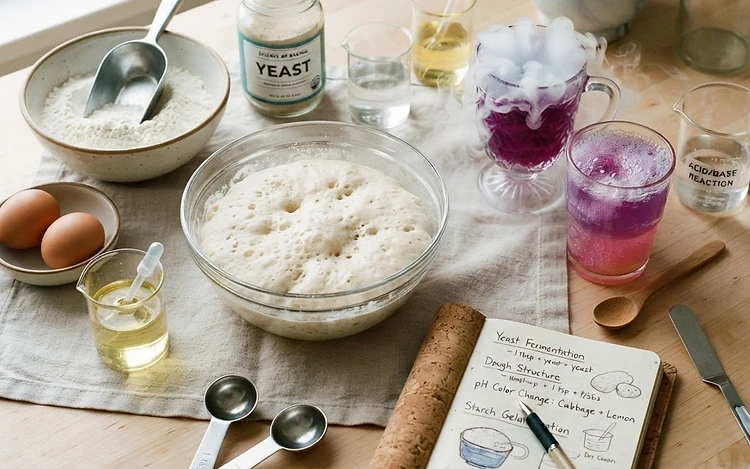
Cooking is more than just making food — it's an exciting science experiment happening right in your kitchen! Whether it's the way ingredients combine, how heat changes textures, or how gas creates bubbles, cooking offers endless opportunities to teach kids about the science behind their meals. You can easily introduce them to chemistry, biology, and physics concepts with a dash of creativity. Here are detailed ideas and lists of supplies for fun cooking experiments you can try with your kids, turning your kitchen into a mini science lab.
Take breaks when needed according to the attention span of your children and your own. When this endeavor becomes a chore, the positive aspects of learning are lost. The point is to bond and learn surprising things from, and with, your family.
Gather Your Supplies
The Provisions
Props
- Cookie dough ingredients: butter, sugar, flour, eggs, baking soda or baking powder
- Baking sheets and cooling racks
- Yeast (active dry yeast), warm water, sugar, flour, oil, salt, mixing bowl
- Dry ice (with safety gloves and tongs), warm water, large bowl
- Salad dressing ingredients: oil, vinegar/lemon juice, egg yolk, mustard, whisk or blender
- Purple cabbage, lemon juice, baking soda, water, glass containers, strainer
- Optional: food coloring or glow-in-the-dark materials for extra effect
- Notebook for recording observations
Recipes & Food
- Baked cookies: demonstrate heat, caramelization, and leavening agents producing CO2
- Rising bread or pizza dough: yeast feeds on sugar and releases carbon dioxide
- Dry ice fog punch: dry ice sublimates in warm liquid, creating bubbling fog
- Homemade mayonnaise or salad dressing: emulsification with egg yolk as the emulsifier
- Color-changing lemonade: purple cabbage juice reacts to acidic lemon juice and basic baking soda
Language & Music
- Learn science terms: caramelization, leavening, fermentation, sublimation, emulsification, pH
- Discuss chemical reactions: how heat changes ingredients at a molecular level
- Explain the role of lecithin in egg yolks as an emulsifier
- Discuss anthocyanins in purple cabbage as natural pH indicators
- Record observations in a notebook before, during, and after each experiment
Peripherals
- Science notebook for recording observations and hypotheses
- Safety gloves and tongs for handling dry ice
- Measuring spoons and cups for precise ingredient amounts
- Strainer for purple cabbage juice
- Optional: food coloring for extra visual effects
Your Week of Wonder
The Five-Day Itinerary
Day 1
Heat and Chemical Reactions: The Magic of Baking
- Gather cookie dough ingredients: butter, sugar, flour, eggs, baking soda or baking powder
- Mix the dough and let kids observe the ingredients before baking
- Bake the cookies and discuss: sugar caramelizes, butter melts, leavening agents produce CO2
- Observe changes before, during, and after baking — how does the dough rise and puff up?
- Record observations in a science notebook
- Enjoy the cookies for dinner dessert while discussing the chemistry
Day 2
Rising Dough: The Magic of Yeast and Gas
- Gather yeast, warm water, sugar, and pizza/bread dough ingredients
- Mix yeast with warm water and sugar — discuss how yeast is a living organism that feeds on sugar
- Mix the dough and let kids observe how it changes over time as it rises
- Experiment with different water temperatures to see how fast the dough rises (too hot = yeast dies, too cold = won't activate)
- Bake the bread or pizza and discuss how CO2 gas got trapped in the dough
- Record observations and enjoy the bread for dinner
Day 3
Bubbling and Fizzing: The Chemistry of Carbonation
- Gather dry ice (with safety gloves), warm water, and a large bowl
- Add dry ice to warm water and watch it sublimate — going from solid to gas
- Discuss: dry ice is solid CO2, it creates bubbling fog as it turns to gas
- Explain that this is the same reason sodas fizz — carbon dioxide creates the bubbles
- Optional: add food coloring or glow-in-the-dark materials for extra effect
- Prepare dinner and discuss the science behind the fog
Day 4
Emulsification: The Science of Mixing Ingredients
- Gather salad dressing ingredients: oil, vinegar/lemon juice, egg yolk, mustard
- Discuss: oil and water don't naturally mix because they're immiscible
- Let kids pour oil slowly and whisk rapidly to create a creamy texture
- Explain: egg yolk contains lecithin, which acts as an emulsifier binding oil and water
- Discuss how more mixing creates a more stable emulsion
- Make homemade mayonnaise or salad dressing and serve with dinner
Day 5
Color-Changing Lemonade & The Final Science Dinner!
- Make purple cabbage juice by straining blended or boiled purple cabbage
- Pour cabbage juice into glass containers — it's purple (neutral pH)
- Let kids add lemon juice (acidic) and watch the color change to red/pink
- Add baking soda (basic) and watch it turn green/blue
- Discuss: anthocyanins in cabbage juice react to different pH levels
- Experiment with different amounts of baking soda and lemon juice to see color shifts
- Serve all the science experiments together: cookies, bread, fog punch, dressing, and color-changing lemonade
- Review all observations in the science notebook and discuss what you learned

