Greek Mythology Dinner
Dine with the gods of Olympus — research the myths, then feast like heroes.

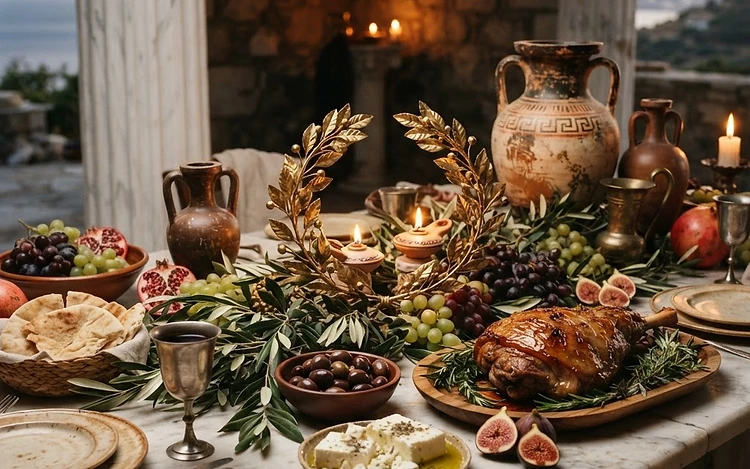
Step into the world of Mount Olympus. A Greek Mythology Dinner invites your family to research the gods, heroes, and monsters of ancient Greece during the week, then bring those stories to life at the table. Each family member adopts a god or goddess, learns their myths, and shares them over a feast of real Greek food. It's a wonderful way to combine storytelling, history, and cooking for kids who are ready for deeper research.
Take breaks when needed according to the attention span of your children and your own. When this endeavor becomes a chore, the positive aspects of learning are lost. The point is to bond and learn surprising things from, and with, your family.
Gather Your Supplies
The Provisions
As an Amazon Associate we earn from qualifying purchases at no extra cost to you.
Props
- Gold paper or fabric to craft laurel wreaths for each family member
- A "Mount Olympus" backdrop — a painted poster or printed image of the mountain
- Candle or LED pillar candle for a "sacred flame" centerpiece
- Index cards for each family member's god or goddess with their name, domain, and symbol
- A bowl of "ambrosia" (honey-yogurt dip) and "nectar" (sparkling juice)
Language & Music
- Learn Greek greetings: "Yiasou" (hello/goodbye), "Efharisto" (thank you)
- Learn the names of the twelve Olympian gods and their Roman counterparts
- Practice the Greek alphabet — learn to write your name in Greek letters
- Discuss the word "myth" and the difference between myths, legends, and history
Peripherals
- Task worksheet to post on the fridge
- A printed map of ancient Greece showing Athens, Sparta, and Mount Olympus
- D'Aulaires' Book of Greek Myths (or a similar collection) for nightly reading
- A Greek mythology documentary or animated video for movie night
Your Week of Wonder
The Five-Day Itinerary
Monday
Choose Your God & Plan the Feast
- Introduce the theme and show the map of ancient Greece. Each family member chooses a Greek god or goddess to represent at the final dinner (Zeus, Athena, Poseidon, Artemis, Apollo, Hades, etc.).
- Brainstorm the Greek menu together and make a shopping list. Assign each person a dish to research or help prepare.
- Begin reading a Greek myth together at dinner — start with the story of how the gods defeated the Titans.
Tuesday
Research Your God or Goddess
- Each family member researches their chosen god or goddess: their domain (e.g., Athena = wisdom, Poseidon = the sea), their symbols, their family tree, and one famous myth they appear in.
- Write the findings on an index card to display at the final dinner.
- During dinner, each person shares one fact about their god. Discuss which gods seem most powerful and why.
Wednesday
Laurel Wreaths & Greek Alphabet
- Craft laurel wreaths from gold paper or fabric — cut leaf shapes and attach them to a circular base. Everyone wears theirs at the final dinner.
- Learn the Greek alphabet together. Try writing each family member's name in Greek letters.
- During dinner, read the myth of Prometheus stealing fire from the gods, or Persephone and the seasons.
Thursday
Labors of Hercules & Prep
- Read or retell the Twelve Labors of Hercules. Discuss what "labors" or challenges your family has overcome together.
- Begin food prep: make tzatziki, prepare the spanakopita, or assemble the baklava if making from scratch.
- Set up the Mount Olympus backdrop and plan the table arrangement for tomorrow.
Friday
The Feast of Olympus
- Everyone wears their laurel wreath and places their god or goddess card at their seat. Light the "sacred flame" centerpiece.
- Cook the feast together — souvlaki on skewers, Greek salad, warm pita, and spanakopita. Serve the "ambrosia" dip and "nectar" juice.
- During dinner, each person presents their god or goddess: their domain, their symbol, and their favorite myth. The family votes on the most fascinating god.
- Finish with baklava and a final myth read aloud — the story of Odysseus and his journey home.

